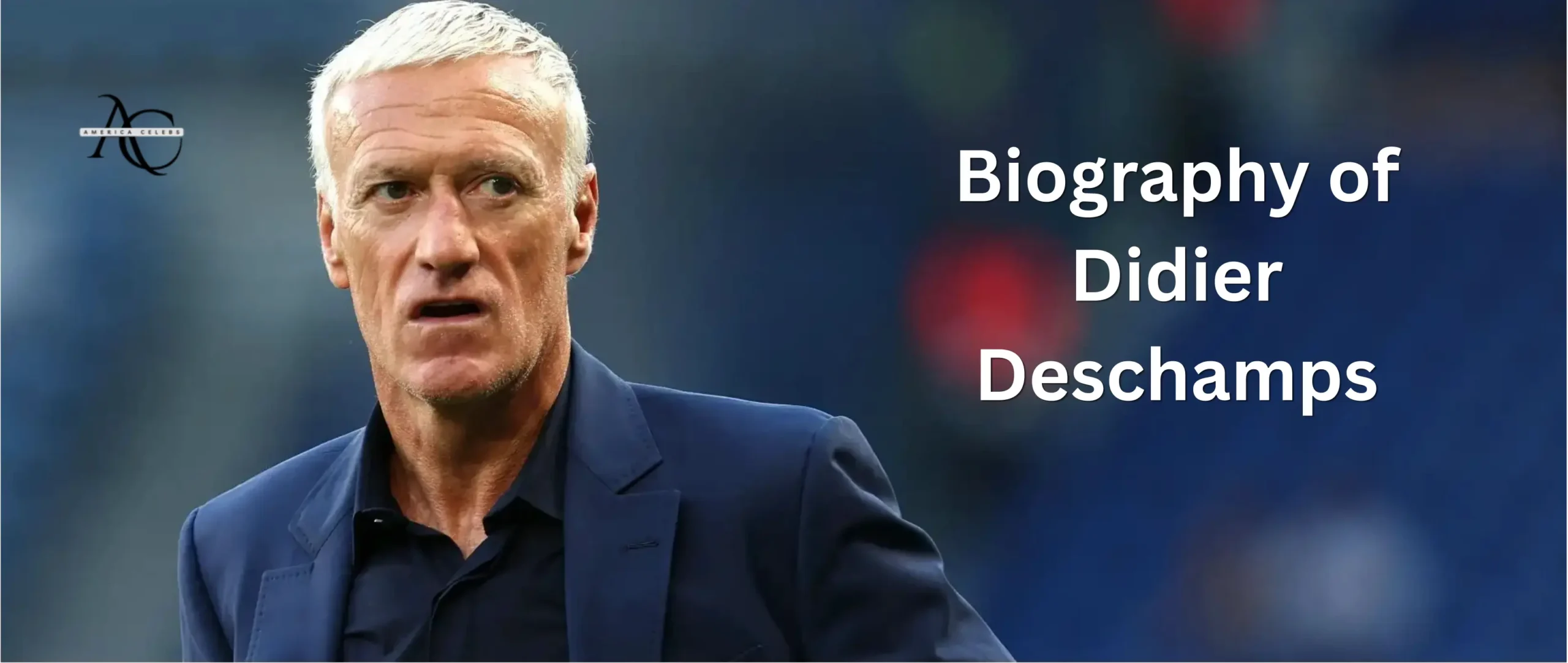
Didier Deschamps Net Worth 2026: Playing Legacy, Coaching Empire and Life After France
Only three people in the history of football have won the FIFA World Cup as both a player and a head coach. Didier Deschamps is one of them. Born in Bayonne, raised in southwest France, and forged across the most demanding club environments in Europe, he spent his entire career doing things that most people in the sport simply told him could not be done.
This is the complete breakdown of Didier Deschamps’s net worth in 2026, his income sources, his playing and coaching career, his personal life, and what happens when France’s most successful manager steps away from Les Bleus after the 2026 World Cup.
| $245M Estimated Net Worth | 3.8M Annual Salary (Euros) | 103 International Caps | 2 World Cups Won (Player + Coach) |
Didier Deschamps Quick Profile 2026
| Full Name | Didier Claude Deschamps |
| Born | October 15, 1968, Bayonne, France |
| Age in 2026 | 57 years old |
| Nationality | French |
| Height | 5 ft 9 in (174 cm) |
| Position (Player) | Defensive Midfielder |
| Playing Career | 1985 to 2001 |
| Clubs Played | Nantes, Marseille, Bordeaux (loan), Juventus, Chelsea, Valencia |
| International Caps | 103 caps for France (1989 to 2000) |
| Nickname | The Water Carrier |
| Coaching Career | 2001 to present |
| Clubs Managed | AS Monaco, Juventus, Olympique Marseille |
| National Team | France (2012 to 2026) |
| Major Titles Won | 1998 World Cup (player), Euro 2000 (player), 2018 World Cup (coach) |
| Net Worth 2026 | $245 million (estimated) |
| Annual Salary | 3.8 million euros as France head coach |
| Wife | Claude Antoinette (married 1989) |
| Son | Dylan Deschamps (born 1996) |
| Post-2026 Plans | Stepping down after 2026 World Cup; club return hinted |
Who Is Didier Deschamps? Early Life in Bayonne
Didier Claude Deschamps was born on October 15, 1968 in Bayonne, a city in the Basque Country of southwest France. His father Pierre was a house painter and his mother Ginette worked as a wool saleswoman. It was a working-class upbringing in a sports-mad region, and from early childhood, football was the constant.
He joined the youth system at Nantes, one of France’s most respected footballing academies, spending two years developing his game before breaking into the senior team in September 1985. In four seasons with Nantes he scored four goals in 111 appearances, a number that tells you everything about what kind of player he was. Goals were never his job. Winning was his job.
When he was 19 years old, his brother Philippe died in a plane crash. It was a tragedy he has spoken about throughout his life with quiet gravity. In a 2022 interview he said it is something you live with, that you can never forget, and that it makes you live differently. It hardened him. That hardness became the foundation of everything he achieved afterward.
Playing Career: From Nantes to the World Cup Final
Deschamps moved to Olympique Marseille in 1989 for a transfer fee of approximately 459,000 pounds. It was the beginning of the most decorated phase of his playing life. At Marseille he won back-to-back Ligue 1 titles in 1991 and 1992, and then, in 1993, he captained the club to the UEFA Champions League final against AC Milan, a team filled with Marco van Basten, Paolo Maldini, Franco Baresi, and Frank Rijkaard. Marseille won. It was the first and remains the only Champions League title ever won by a French club.
He was the youngest captain in Champions League history to lift the trophy at that point. He was 24 years old.
The Juventus Years, 1994 to 1999
In 1994, Juventus bought him for approximately 4.95 million pounds and brought him to Turin. Under manager Marcello Lippi, Deschamps formed partnerships with Antonio Conte, Zinedine Zidane, and Edgar Davids in one of the most dominant midfields in European football history. In five years at Juventus he won three Serie A titles, one Coppa Italia, two Italian Supercups, a second Champions League title in 1996, a UEFA Super Cup, and an Intercontinental Cup. He played in two consecutive Champions League finals.
His former teammate Eric Cantona gave him a nickname during this period that followed him for the rest of his career: the water carrier. It was intended as a slight, a suggestion that Deschamps did only the unglamorous work so that more talented players could flourish around him. Deschamps wore it as a badge of honour. He knew exactly what he was and he was absolutely the best at it.
Chelsea and Valencia, 1999 to 2001
He moved to Chelsea in 1999 for 1.8 million pounds and helped the club win the FA Cup in the 1999 to 2000 season. A brief spell at Valencia followed before he retired from professional football in 2001 at the age of 32.
France: 103 Caps, One World Cup, One Euro
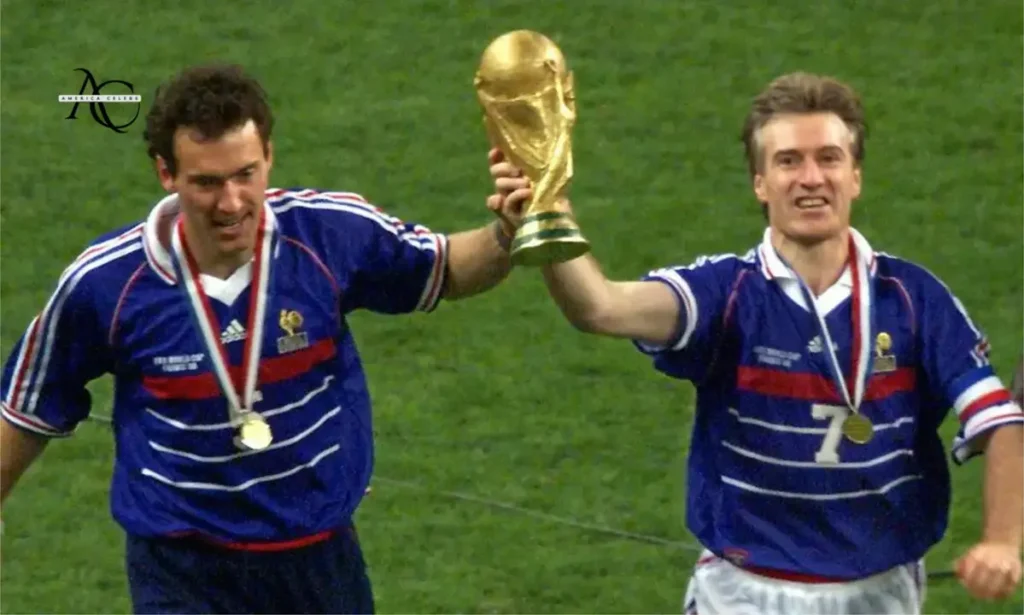
Between 1989 and 2000, Deschamps earned 103 caps for the French national team. He captained the team to victory in the 1998 FIFA World Cup on home soil, lifting the trophy after a 3-0 win over Brazil in Paris. Two years later he captained France to victory at Euro 2000. He was the leader of the generation that French football has simply called les Bleus of 1998, a group that included Zinedine Zidane, Thierry Henry, Patrick Vieira, and Robert Pires.
| It is something you live with. You can never forget it. Live differently, it hardens you. Didier Deschamps on the death of his brother Philippe, via Canal+ |
Coaching Career: From Monaco to the World Stage
Deschamps retired as a player in 2001 and began coaching almost immediately. He did not take time off. He had been studying the game from a leadership position his entire career and he was ready.
AS Monaco, 2001 to 2005
At Monaco, Deschamps won the Coupe de la Ligue in 2003 and in 2004 guided the club to the UEFA Champions League final, the first in Monaco’s history. They lost to Jose Mourinho’s Porto in the final. For a club of Monaco’s size and resources to reach the final of Europe’s premier competition was a coaching achievement that immediately marked Deschamps as a serious managerial talent.
Juventus, 2006 to 2007
After Monaco he returned to Juventus, the club where he had enjoyed his greatest playing success. The context was completely different. Juventus had been relegated to Serie B following the Calciopoli match-fixing scandal. Deschamps took the job, won Serie B in the 2006 to 2007 season, and returned the club to the top flight of Italian football in a single season. He left after that mission was complete.
Olympique Marseille, 2009 to 2012
At Marseille he ended the club’s 17-year title drought by winning Ligue 1 in the 2009 to 2010 season. He added five more trophies over three years, including two Coupes de la Ligue and two Trophees des Champions. He won the Ligue 1 Manager of the Year award and built a reputation as a tactician who could organise, motivate, and sustain excellence over multiple seasons.
Managing France: 14 Years, One World Cup, Three Finals
In July 2012, Deschamps was appointed head coach of the French national team, succeeding Laurent Blanc. He became France’s longest-serving national team manager in history. What he built over the following 14 years is genuinely without parallel in French football.
His early tournaments were respectable without being spectacular. France reached the quarter-finals of the 2014 World Cup in Brazil and the final of Euro 2016 at home, losing to Portugal in extra time. That final defeat was brutal. The tournament had been held in France, the crowd was behind them, and they lost. Any lesser manager might have crumbled.
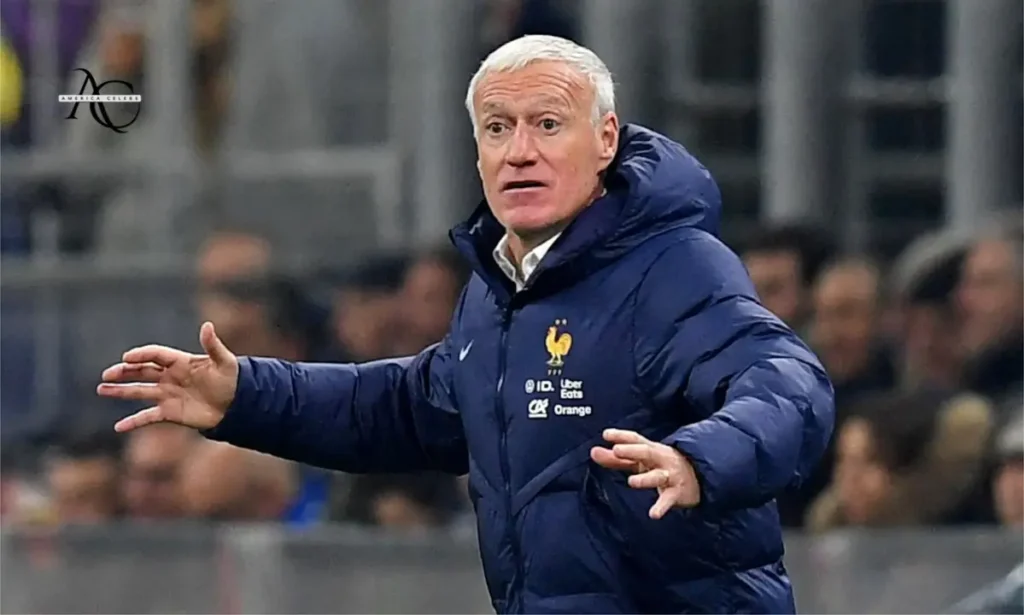
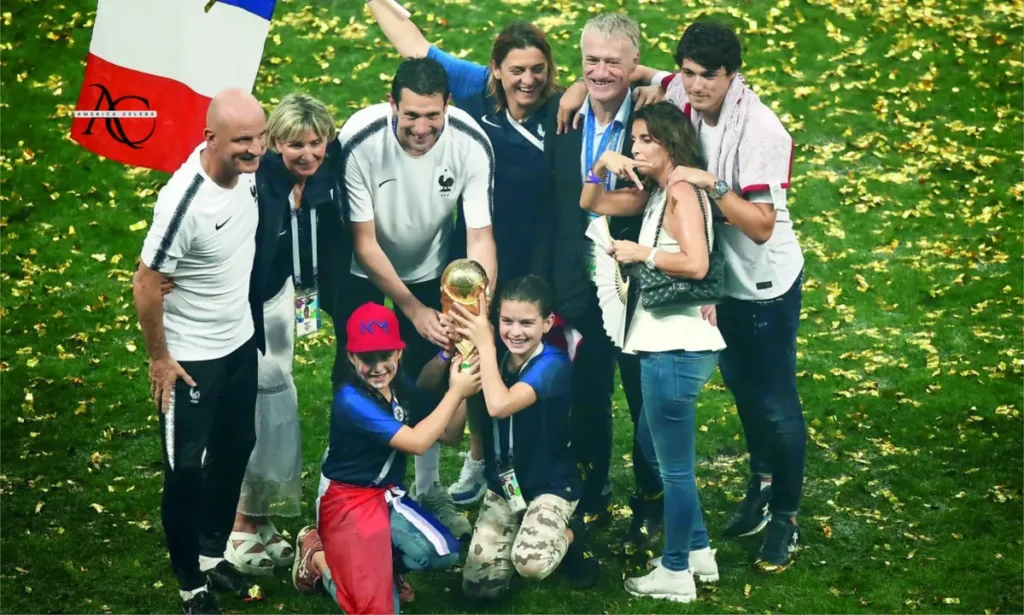
Then came Russia 2018. With a squad featuring Kylian Mbappe at 19 years old, Antoine Griezmann, Paul Pogba, and Raphael Varane, Deschamps built a team that was relentless rather than dazzling. France won the World Cup, defeating Argentina 4-2 in the final. Deschamps became only the second person in history to win the FIFA World Cup as both a player and a head coach, following Franz Beckenbauer.
In Qatar 2022, France reached the final again, this time losing on penalties to Argentina after one of the most dramatic final matches in tournament history. Mbappe scored a hat-trick in the second half to pull France level. They were 30 seconds from forcing a shootout they might have won. It ended 4-2 on penalties after a 3-3 draw. It was a heartbreaking finish that many in France still debate.
In January 2025, Deschamps confirmed publicly on TF1 that he will leave the France role after the 2026 World Cup. In his words: in 2026 it will be over. In my head it is very clear. Zinedine Zidane has been widely linked as his successor.
Didier Deschamps Net Worth 2026
As of 2026, Didier Deschamps’s net worth is estimated at approximately $245 million. This figure has been reported consistently across multiple financial tracking sources and reflects a career spanning more than four decades in professional football at the highest level.
- Playing career earnings: Over 16 years as a professional player at clubs including Juventus, Chelsea, and Marseille, Deschamps accumulated substantial earnings from salaries, signing fees, and performance bonuses. Peak earners at top European clubs in the 1990s commanded salaries in the range of hundreds of thousands of pounds per year.
- Coaching salaries: His annual salary as France head coach is reported at 3.8 million euros per year, placing him among the highest-paid international football managers in the world. Over 14 years that represents cumulative coaching salary earnings in the range of 50 million euros from the national team alone, not counting his club tenures at Monaco, Juventus, and Marseille.
- Property and investments: Multiple sources indicate Deschamps has made substantial property investments throughout France and across Europe, adding significant passive wealth to his income portfolio over the decades.
- Endorsements and commercial work: Over his playing career and high-profile coaching tenure, Deschamps has been associated with commercial partnerships and brand endorsements that have contributed to his overall wealth.
Personal Life: Family, Marriage, and the Man Behind the Tactics
Deschamps married Claude Antoinette in 1989, the same year he joined Marseille. They have been together for over three decades and have one son, Dylan, born in 1996. The family has maintained a genuinely private life given the level of public scrutiny that comes with managing the French national team for 14 years.
Dylan was born during his father’s Juventus years and grew up watching Deschamps manage at the highest levels of the game. The family’s ability to stay grounded amid extraordinary success is something Deschamps has spoken about in interviews as a deliberate and necessary choice.
The loss of his brother Philippe in a plane crash when Deschamps was 19 remains a defining part of who he is. He rarely gives interviews where it does not come up in some form, not as a story of grief but as an explanation for his relentlessness, his discipline, and his refusal to take anything in the game or in life for granted.
Life After the 2026 World Cup
Deschamps has confirmed that 2026 marks the end of his time with France. He has hinted at a possible return to club management, and his name has been mentioned in connection with several high-profile European positions including Tottenham Hotspur following their managerial upheaval in 2025.
Given what he achieved at Monaco, Juventus, and Marseille before the France job, a return to club football would be entirely consistent with his career pattern. He has never been a manager who stayed in one place longer than the project demanded, and his record shows he can deliver at every level of the game.
His legacy with France is already secured regardless of what happens at the 2026 tournament. He is the longest-serving manager in the team’s history. He is the only man to captain France to a World Cup and then coach them to another. He guided Les Bleus through 14 years without a single year of genuine crisis or collapse.
FAQs
Q1: Why is Didier Deschamps called the water carrier?
The nickname was given to him by his former France teammate Eric Cantona, who used it to suggest that Deschamps only did the unglamorous defensive work in midfield so that more technically gifted players could shine around him. Deschamps accepted and embraced the label rather than resenting it. His role was to win the ball, protect the defence, and start attacking moves. He was the best in Europe at doing exactly that for nearly a decade, and the teams he played in won almost everything because of it.
Q2: How many trophies did Deschamps win as a player?
His trophy haul as a player includes two UEFA Champions League titles, one with Marseille in 1993 and one with Juventus in 1996, three Serie A championships, two Ligue 1 titles, one Coppa Italia, two Italian Supercups, one UEFA Super Cup, one Intercontinental Cup, one FA Cup with Chelsea, the 1998 FIFA World Cup as captain of France, and UEFA Euro 2000 as captain of France. He is one of the most decorated defensive midfielders in the history of European football.
Q3: What did Deschamps achieve at Juventus as a coach?
His coaching stint at Juventus came in the 2006 to 2007 season under extraordinary circumstances. The club had been relegated to Serie B following the Calciopoli match-fixing scandal that stripped them of two Serie A titles and removed them from European competition. Deschamps took charge, won Serie B in his one season, and returned Juventus to top-flight Italian football. He then departed, his mission complete. It remains one of the more underrated managerial achievements in modern Italian football.
Q4: Who is expected to replace Deschamps as France manager after 2026?
Zinedine Zidane is widely regarded as the overwhelming favourite to succeed Deschamps. The two men were teammates in the French golden generation of 1998 and won the World Cup together as players. Zidane went on to win three consecutive UEFA Champions League titles as Real Madrid manager between 2016 and 2018. He has publicly stated his desire to manage the French national team on multiple occasions. French football federation president Philippe Diallo has confirmed that the question of succession will be addressed after the 2026 World Cup.
Q5: What is the significance of Deschamps winning the World Cup as both player and coach?
Only two people in the history of football have won the FIFA World Cup as both a captain and a head coach: Franz Beckenbauer of West Germany, who played in the 1974 final and managed the 1990 winning team, and Didier Deschamps, who captained France in 1998 and coached them to victory in 2018. It is an achievement that requires exceptional success across two completely different and demanding careers within the same sport. For Deschamps, who was told his playing style was too simple to merit greatness, it is perhaps the most complete answer possible.
Wrapping Up
Didier Deschamps is 57 years old, has an estimated net worth of $245 million, and has been part of more defining moments in French football than any other person alive. He started as a kid in Bayonne who was told he carried water for better players. He ended up being one of only two men in the history of the sport to win the World Cup at both ends of the touchline.
His story is not about natural talent overcoming adversity. It is about intelligence, discipline, and a profound understanding of what football actually requires from leadership. He knew what his role was as a player and he played it better than anyone. He knew what his role was as a manager and he held France at the top of world football for 14 consecutive years.